Dublin's Data Centers Are Heating Universities - The Heat Reuse Revolution
While the rest of the world debates AI's energy problem, Dublin is quietly turning it into a solution. Data centers aren't just consuming power in Tallaght—they're heating campuses, homes, and public buildings. Here's what data engineers should know about sustainable infrastructure.
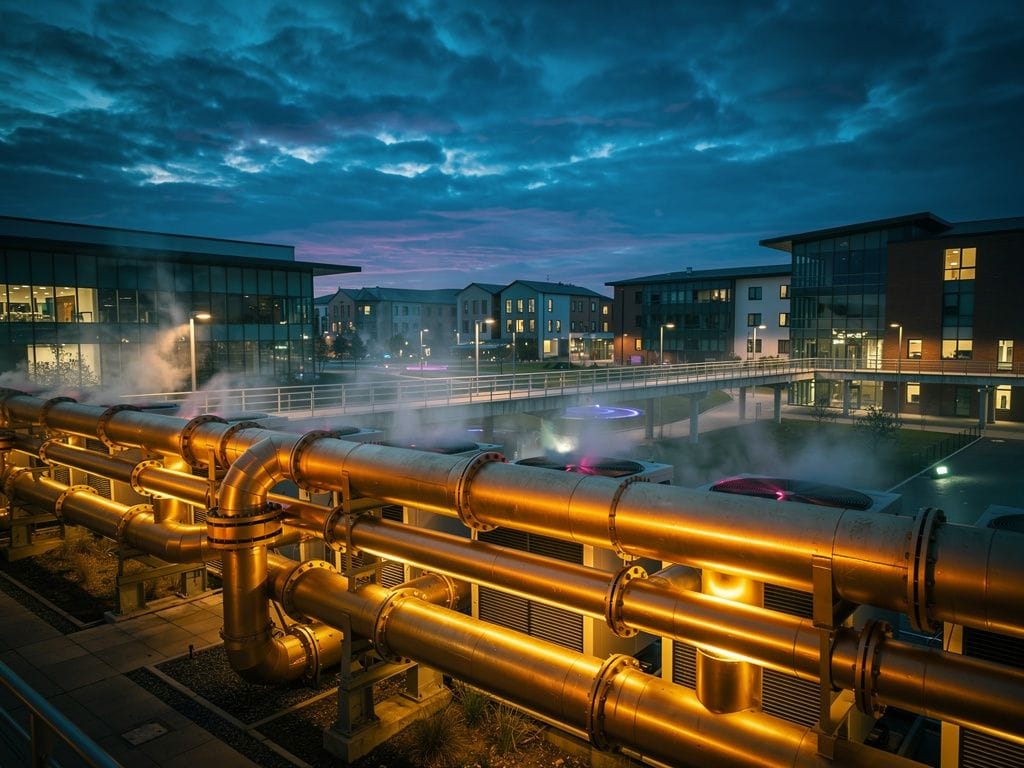
Dublin's Data Centers Are Heating Universities: The Heat Reuse Revolution
Standing outside the Technical University of Dublin's Tallaght campus on a rainy Tuesday, I watched students walk into buildings heated by the same data centers everyone says are destroying the planet. The contradiction struck me immediately: the narrative of AI's energy apocalypse was colliding with something more complicated on the ground.
The AI data center boom does consume enormous electricity. It does strain grids. But in Dublin, the waste heat is not vented into the atmosphere—it is piped into universities, offices, and affordable housing. What looks like an energy problem from Silicon Valley looks like an infrastructure opportunity from Tallaght.
This is the heat reuse revolution, and it is happening twenty minutes from my apartment.
The Microgrid That Changed the Conversation
In March 2026, a new microgrid came online in Tallaght that should make every data engineer pause and reconsider what sustainable infrastructure looks like. The installation connects Amazon Web Services data centers to the Technical University of Dublin's campus, using excess heat to warm classrooms, laboratories, and student housing.
The timing matters. This microgrid announcement arrived just as global anxiety about AI's energy consumption reached fever pitch. While policymakers in other jurisdictions debated moratoriums and restrictions, South Dublin County Council was completing infrastructure that turns waste heat into public good.
The CNBC coverage of this trend captured the irony succinctly: AI's energy problem may also be its solution. But what the international coverage misses is the local specificity that makes Dublin's approach work.
How the Tallaght District Heating Scheme Actually Works
The Technical University of Dublin's Tallaght campus has been heated by AWS data center waste heat since 2023. The March 2026 microgrid expansion represents an evolution of this existing infrastructure, not a greenfield experiment.
The mechanics are conceptually straightforward, though the engineering is sophisticated. Data centers generate enormous amounts of heat cooling their servers. Conventionally, this heat is expelled through cooling towers into the atmosphere—wasted energy. In Tallaght, that thermal energy is captured through heat exchangers, piped through insulated distribution networks, and delivered to buildings that need heating.
The technical stack involves several components. At the data center, air-to-water heat exchangers extract thermal energy from the exhaust air of server halls. This heated water—typically at 40-60°C—is then boosted through heat pumps to achieve temperatures suitable for space heating (60-80°C). The thermal energy travels through pre-insulated underground pipes to substations in connected buildings, where it transfers to the buildings' own heating distribution systems.
The network currently serves:
- The Technical University of Dublin Tallaght campus (multiple buildings including laboratories with high heat demand)
- 133 affordable apartments in the surrounding area
- Local community buildings and public sector offices
- Additional public-sector buildings and commercial spaces added through the March 2026 expansion
The heat is, in Amazon's framing, "free." This is technically accurate—the heat is a byproduct that would otherwise be wasted. But the infrastructure to capture and distribute it is anything but free. The capital investment includes heat exchangers, pumps, distribution piping, and building substations. The operational commitment involves maintenance, monitoring, and continuous optimization of the thermal network. South Dublin County Council and their Heatworks partnership provide the public infrastructure layer that makes this private-public coordination possible.
Why Dublin? Why Now?
Dublin's heat reuse success is not replicable everywhere. The city has specific advantages that make district heating from data centers viable:
Density of demand: Tallaght has a concentrated cluster of buildings that need heating—university campus, affordable housing, public facilities—within a short distance of major data center operations. The heat load density justifies the infrastructure investment.
Cooling needs: Ireland's climate means data centers still require substantial cooling year-round, but the temperature differential is manageable compared to hotter regions. This makes heat capture technically feasible without extreme engineering.
Regulatory environment: South Dublin County Council has been unusually proactive in enabling this infrastructure. The council's partnership with Heatworks and AWS represents a level of public-private coordination that other jurisdictions have struggled to achieve.
Energy context: Ireland's electricity grid constraints have made data center expansion politically sensitive. Heat reuse provides a reputational and practical benefit that helps justify continued investment.
The Data Engineer's Perspective
I build data pipelines for a living. The Tallaght scheme interests me for reasons beyond environmental virtue signaling—it represents a different way of thinking about infrastructure efficiency.
In my day job at OptumRx, I optimize ETL pipelines constantly. The goal is always the same: extract maximum value from computational resources. If a transformation step generates intermediate data that another process could use, we design the pipeline to pass it along. Waste is inefficiency. Inefficiency is cost.
The Tallaght district heating network applies this same principle to physical infrastructure. The heat is intermediate output. The campus and housing are downstream consumers. The engineering challenge is building the pipe.
This is not merely analogy. Data engineers are increasingly responsible for sustainability metrics in their organizations. According to recent reporting, the "heat economy" emerging around data centers is becoming a material factor in site selection and corporate sustainability reporting.
If your organization operates data infrastructure in Europe, you should understand how heat reuse works. It may soon be part of your job description.
The Skeptic's View
I want to acknowledge the limitations here, because heat reuse is not a panacea. The Tallaght scheme works, but it works in a specific context that does not automatically translate elsewhere.
First, the scale is still modest. The Tallaght scheme serves a specific geographic footprint measured in kilometers, not tens of kilometers. Heat reuse improves the utilization factor—it does not eliminate the underlying energy consumption. A data center consuming 50 megawatts still consumes 50 megawatts, even if some of the waste heat warms nearby buildings.
Second, heat reuse requires proximity and density. You cannot ship waste heat across continents economically—the thermal losses through long-distance pipes make it impractical. Data centers in isolated rural locations or regions with dispersed populations cannot participate in district heating schemes. This constraint eliminates most of the world's data center capacity from heat reuse economics.
Third, the economics remain dependent on public subsidy and partnership. Without South Dublin County Council's infrastructure investment and the Heatworks operational framework, this network likely does not get built. The private sector alone rarely finances district heating because the payback periods are long and the regulatory coordination is complex.
Fourth, the carbon accounting is genuinely complex. If the data center runs on fossil-fuel-generated electricity, the heat it produces carries that carbon intensity. Heat reuse improves the overall efficiency of the energy system—less waste—but it does not automatically make the underlying energy clean. A natural-gas-powered data center distributing waste heat is still emitting carbon, just more efficiently.
Finally, there is a legitimate concern about greenwashing. Data center operators promoting heat reuse initiatives while continuing to expand fossil-fuel-powered capacity can use these schemes as reputational cover. Heat reuse is a genuine efficiency improvement, but it should not distract from the larger challenge of decarbonizing data center energy sources.
What Comes Next
The Tallaght model is spreading. Amazon has signaled interest in expanding district heating partnerships to other facilities where the geography permits. Other hyperscalers are watching closely.
For data engineers, the practical implication is that sustainability is becoming a locational constraint. When your organization selects a data center region, carbon intensity of the grid now matters. But so does the potential for heat reuse, circular economy partnerships, and community integration.
The question is no longer simply: "Which region has the cheapest compute?"
The question is becoming: "Which region lets us do compute with the lowest total environmental impact, including what we do with the waste?"
The engineers who answer this question well—who understand both data infrastructure and thermodynamics, who can model energy flows as fluently as they model data flows—will shape where this infrastructure goes next. The specialization that once seemed academic is becoming commercially decisive.
I am watching this transformation from Dublin. I suggest you start watching from wherever you are.
Simon Cullen
Principal Data Engineer, Dublin
5 February 2026