The Charity in the Machine
The future of AI was supposed to be decided by models and chips. In Oakland, it is being tested by something older: a charitable promise.
The future of AI was supposed to be decided by models, chips, and whoever found enough electricity first. In Oakland, it is being tested by something older: a charitable promise.
Listen to This Article
Narrated in Onyx — one full 11-minute version, stitched from Venice TTS chunks.
The Summary
At 8:13 p.m. in Dublin, a model summarized a trial about the industry that made it and forgot the only honest machine in the building.
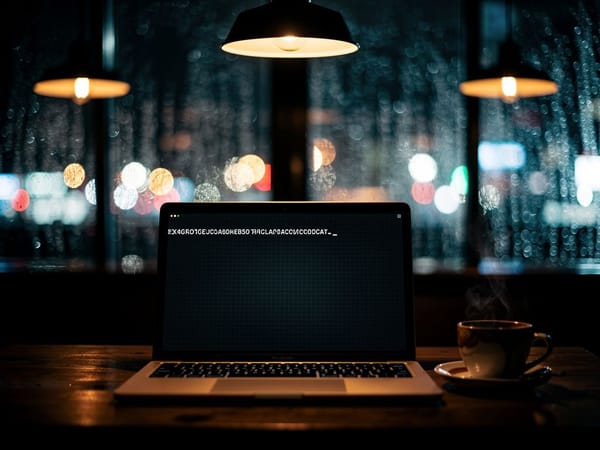
Evening rain had flattened the light against the window. A cold mug sat beside the keyboard. The browser was crowded with tabs: CNN for the cross-examination, NPR for the charitable-trust frame, CNBC for the live updates, KQED for the protesters outside, The Guardian for the queue, the coughing lawyers, the overflow room, and the belt buckle.
I asked for the shape of the Musk v. OpenAI trial. The model gave me parties, claims, remedies, and likely outcomes. Musk alleged betrayal of a nonprofit mission. OpenAI said Musk wanted control, left, built a competitor, and returned wearing public benefit as a weapon. The jury was advisory. The judge controlled remedies.
All true. All clean. It did not mention the beep.
On the first day of the trial in Oakland, according to The Guardian's courtroom reporting, Elon Musk went through the courthouse metal detector twice after his belt set it off. A tiny detail. Almost comic. The richest man in the world, co-founder of the company behind the most famous chatbot on earth, owner of rockets, cars, satellites, and his own AI lab, reduced for a moment to a body, a buckle, and a security instruction.
I had the model's summary on the left of the screen and the courtroom dispatches on the right. The summary was cleaner. The dispatches were truer. I deleted the paragraph the model had given me and started with the machine that beeped.
The Metal Detector
Courts make power physical again.
They take people who are used to private entrances and put them in rooms with wooden benches, bad acoustics, impatient judges, coughing lawyers, and members of the public trying to win one of thirty seats before being sent to an overflow room. They make billionaires empty their pockets. They make founding myths pass through security.
Outside the federal courthouse, KQED found a protester who did not pretend the case belonged to either side. "I'm not here because I care about the outcome of this trial," she said. "I hope it's really expensive for someone and like hurts both companies as much as possible."
That line did more work for me than most of the filings. It broke the spell. The men inside were arguing over who had betrayed humanity. The public outside was less convinced humanity had been invited.
Before the court could decide whether OpenAI had betrayed a charitable mission, everyone had to empty their pockets.
The Certificate
The case began as a feud and became a PDF.
I opened the complaint and searched for the phrase private gain. The cursor jumped past captions, paragraph numbers, and the grey machinery of federal pleading until it reached the sentence that mattered: "The corporation is not organized for the private gain of any person."
There it was, not as branding, not as a keynote promise, but as certificate language quoted in a lawsuit. OpenAI was founded in 2015 as a nonprofit with a public mission: to ensure that artificial general intelligence benefited humanity. The founding certificate also said its property was dedicated to those purposes and that no part of its net income or assets would inure to private persons.
In most companies, sentences like that are compliance furniture. In this one, they became load-bearing.
I pasted the sentence into the model and asked what mattered. It answered with doctrine: charitable trust, unjust enrichment, remedies. Again, it was not wrong. Again, it missed the dangerous part. A sentence that begins life as paperwork can become a machine part.
Musk helped fund OpenAI in its early years. Court reporting commonly puts his contribution around $38 million. A March 2025 court order refers to more than $44 million in undisputed donations, a reminder that even the arithmetic depends on what counts as donation, funding, or something else. Musk says he gave money to a nonprofit project for humanity, not seed capital for a private industrial empire.
OpenAI says the opposite: that Musk understood the need for a for-profit arm, wanted control of it, failed to get that control, left, built xAI, and later used the language of charity against a competitor.
The legal question is narrower and more dangerous than the public argument. It is not simply whether OpenAI was once a nonprofit. It is whether donated assets became subject to a charitable trust — an obligation that can survive changes in corporate form. That is why the possible remedies sound structural rather than symbolic: constructive trust, disgorgement, returning value, forcing corporate paperwork to answer for moral language.
The jury is advisory. Judge Yvonne Gonzalez Rogers may be guided by its view on liability, but if liability is found, the remedies belong to her. The public may get a verdict headline. The real power is quieter than that.
Did the charity's assets become the machine's fuel? And if they did, who has to give something back?
Are You Completely Trustworthy?
On Tuesday, Musk's lawyer opened his cross-examination of Sam Altman with a question that was too clean to be accidental.
"Are you completely trustworthy?"
It is the kind of question that contains its own trap. Say yes and you sound absurd. Say no and you have supplied the headline. Altman answered the way careful witnesses answer: he believed he was an honest and trustworthy businessperson. NPR reported that when asked whether he had always told the truth, he replied that he was sure there were times in his life when he had not.
For a normal executive, that would be banal. For Altman, after the 2023 board revolt, it lands differently.
The trial has pulled that episode back into the room. Former board members and executives have testified about concerns over Altman's candor, his relationship with the board, and the chaotic days when he was removed and then restored. Altman called that period painful, public, and an incredible betrayal. He said he had poured years of his life into OpenAI and watched it nearly be destroyed.
Musk's side wants the jury to see a pattern: a charity gradually captured by operators who learned how to speak mission while building wealth.
OpenAI's side wants the jury to see another pattern: Musk demanding control, losing confidence, leaving in 2018, founding xAI, trying to poach talent, and discovering charitable purity only after OpenAI became too valuable to ignore.
Each side accuses the other of wanting control while claiming to protect humanity from control.
The word humanity has become the most valuable asset in the courtroom.
Bring It Back
Judge Gonzalez Rogers seems determined to keep the trial from floating away.
That may be the most important fact in the case. Not the valuations. Not the private texts. Not even the testimony about who wanted what in 2017. When lawyers veered toward robot armies and the Terminator scenario, The Guardian reported the judge's line: "This is not a trial on the safety risks of artificial intelligence."
The parties want a cosmic trial. Musk wants betrayal of humanity. OpenAI wants competitor weaponizing morality. The press wants billionaires, betrayal, and hostility. The judge wants claims: dates, donations, limitations, duties, remedies. What was promised? To whom? In what form? Who benefited? What can a court actually order?
The model on my desk had reduced the trial too. But the model compressed because compression was the task. The judge compresses because the alternative is theatre. That difference matters.
Not extinction. Charitable trust.
Not destiny. Standing.
Not humanity in the abstract. This corporation, this certificate, this donation, this board, this remedy.
The Strongest Objection
The strongest objection to Musk's case is obvious enough that the article has to admit it: OpenAI may have needed the machine it became.
A lab trying to build frontier AI cannot run on nonprofit romance. It needs clusters, power contracts, researchers, inference capacity, legal teams, security teams, red-teamers, safety evaluators, cloud commitments, and enough capital to survive the interval between awe and revenue. If OpenAI had remained a small charity, it might have preserved its purity and lost the future to someone less sentimental.
There is another objection: Musk is not a disinterested guardian of the public good. He runs xAI. He competes for talent, customers, compute, narrative, and capital. MIT Technology Review reported that he acknowledged xAI uses OpenAI's models to train its own. AP and The Guardian both captured the judge's skepticism when Musk's lawyers tried to make the case about AI risk while Musk builds in the same space.
The court does not need to find him saintly to find the question serious. That is the part worth holding onto.
Bad motives do not automatically dissolve a good legal question. Rivalry does not erase the founding certificate. Hypocrisy is not the same as falsity. Musk can be self-interested and OpenAI can still have a problem. OpenAI can be economically rational and still have converted moral trust into private leverage.
If Musk wins, it does not prove he was the pure one. If OpenAI wins, it does not prove the mission survived intact. The trial is not a morality play, no matter how badly both sides want to cast it as one.
It is closer to an audit.
Not of money alone, but of language.
What I Might Be Wrong About
I might be giving the belt too much weight because the model ignored it.
That is a professional hazard now. I spend my days around systems that compress messy reality into neat outputs: logs into dashboards, incidents into postmortems, documents into summaries, meetings into action items. When the summary misses the one detail that makes the story human, I notice. Sometimes I overcorrect.
The trial may end up being less profound than it looks from Dublin. It may be a competitor lawsuit dressed in charitable language. It may be a fight over control, jealousy, timing, and money, with humanity used as a costume by every side. The advisory jury may find little. The judge may order little. The machine may keep running almost exactly as before.
All of that may be true.
But the certificate will still exist. The donations will still have been made under a public-benefit story. The board crisis will still have shown how fragile the governance structure was when product demand, investor pressure, employee loyalty, and public mythology collided. And the courtroom will still have done something the industry rarely does to itself: forced large claims into small words.
Promise. Asset. Duty. Remedy.
Those words are less glamorous than alignment. They may be more binding.
The Charity in the Machine
A courtroom is a poor place to design AI governance. It is slow, retrospective, adversarial, and dependent on the facts the parties bring. But it has one advantage over the industry it is examining: it remembers that promises are not just content.
A mission statement is not only marketing if people gave money because of it. It is not only culture if employees joined because of it. It is not only mythology if regulators, journalists, investors, and users extended trust because it existed. The phrase "for the benefit of humanity" was never precise. That was its power. It was large enough for researchers, donors, users, employees, investors, and journalists to see themselves inside it.
Later has arrived. And later looks less like a superintelligence than a federal judge telling billionaires to stop litigating the end of the world and answer the question in front of them.
When I finished reading, the summary window was still open on my desk. It had reduced the trial to claims, remedies, and likely outcomes. Outside, the Dublin rain kept flattening the glass. In the record, under the docket numbers and testimony, the older sentence remained: not organized for the private gain of any person.
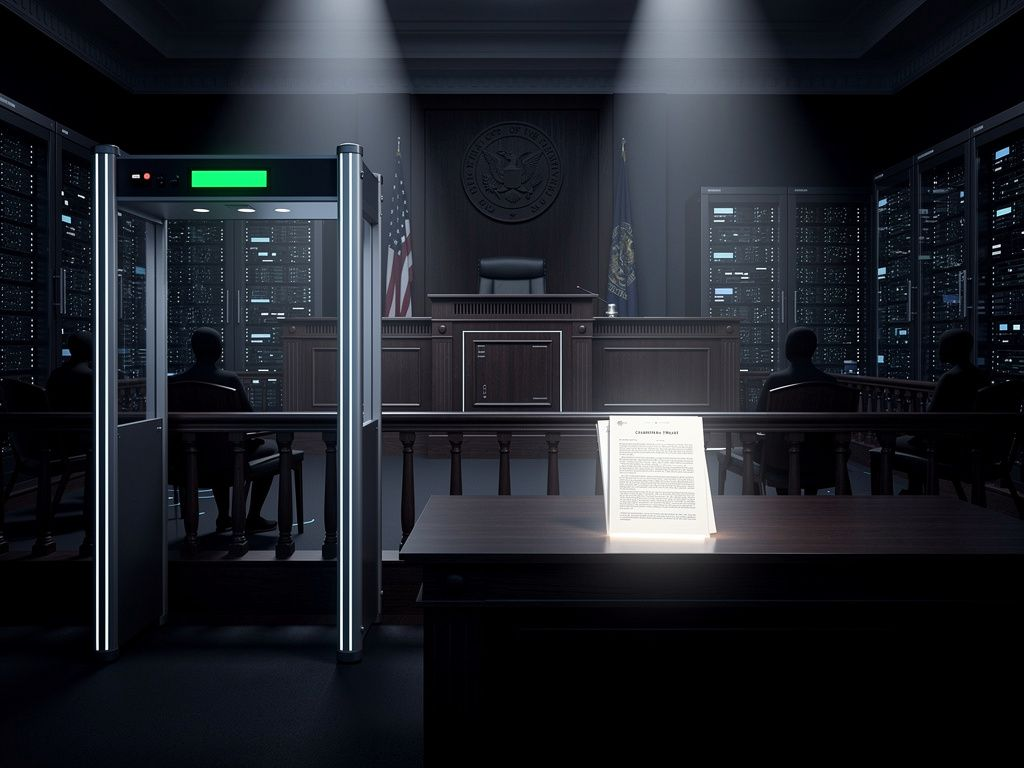
In Oakland, the overflow screen would go dark. The lawyers would pack their exhibits. The public would leave through the same security gates it entered through. Near the entrance, the metal detector would wait in standby, green light on, indifferent to valuation, motive, mission, and myth.
It would not know who was saving humanity.
It would only know what had to be declared.
A data engineer May 2026
Source note: This draft draws on courtroom reporting from CNN, NPR, CNBC, The Guardian, AP, MIT Technology Review, and KQED. Primary legal context comes from the federal complaint, Judge Yvonne Gonzalez Rogers's March 2025 order denying preliminary injunction, the April 2026 pretrial bifurcation order available via GovInfo, and the public docket/document map. Allegations remain allegations unless stated as testimony, court order, or reported courtroom fact. This article does not predict the verdict.