The Machine That Changed Sides
The strangest AI story of May was not a model release. It was a rival's supercomputer becoming Claude infrastructure.
The strangest AI story of May was not a model release. It was a rival's supercomputer becoming Claude infrastructure.
Listen to This Article
Narrated in Onyx — one full 12-minute version, stitched from Venice TTS chunks.
The Rate Limit
The message appeared in the terminal at 11:47 p.m., polite and final: usage limit reached. Claude Code had been rewriting a dbt model. It had found the duplicate join, renamed three macros, and then stopped mid-thought like someone had cut power to the room.
The cursor blinked after a half-written comment. I stared at it longer than I should have. Outside, Dublin was quiet in the way it gets after rain: tyres on wet road, the low hum of a bus at the lights, the window reflecting my own face back at me with the terminal superimposed over it.
The next morning, Anthropic published the answer. Not a new model. Not a safety paper. Compute.
It had signed an agreement with SpaceX to use all of the capacity at Colossus 1, the Memphis supercomputer built by xAI. More than 300 megawatts. Over 220,000 NVIDIA GPUs. H100s, H200s, GB200s. The kind of machine that normally appears in press releases as a national project, not as a rental line item for a rival.
Anthropic announced immediate limit increases — doubled five-hour Claude Code limits on Pro, Max, Team, and Enterprise; removal of peak-hour reductions for Pro and Max; higher Opus API rate limits — alongside a SpaceX deal expected to add Colossus 1 capacity within the month. The terminal message on my screen was not a product problem. It was an infrastructure problem.
Claude needed more machines.
SpaceXAI apparently had capacity it was willing to lease.
The Factory
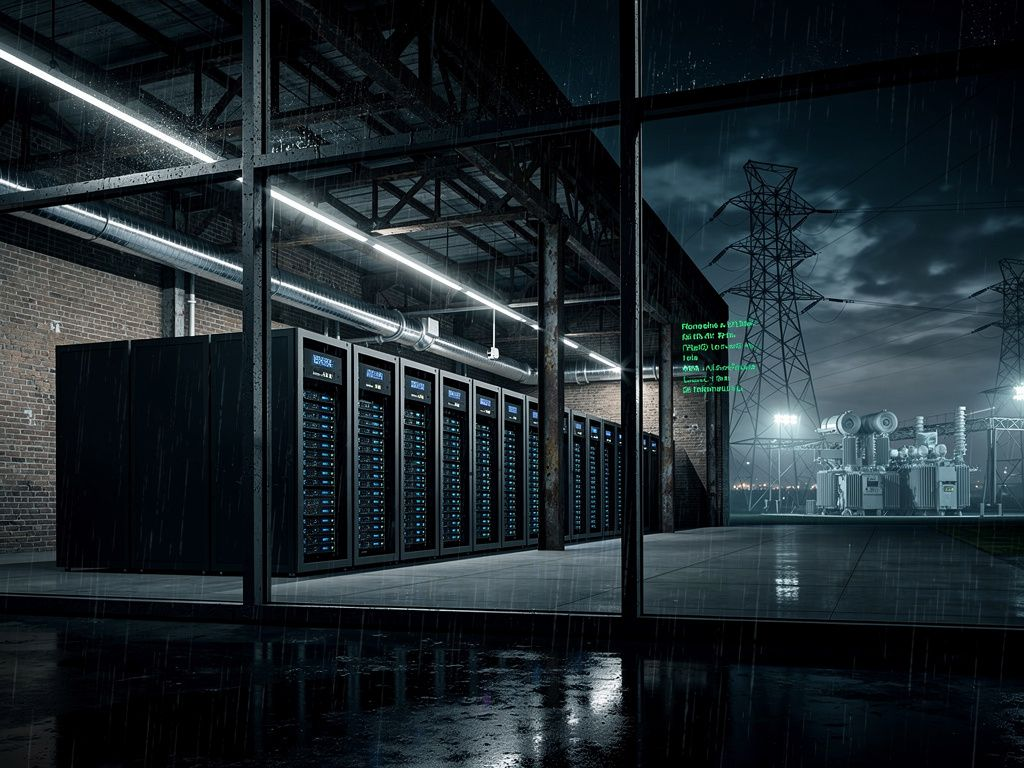
Colossus 1 sits in Memphis, in a former Electrolux factory in Boxtown. I have not been there. I know it only from photographs and filings and the kind of data-center reporting that turns electricity into weather. The building is not the cloud. The cloud is what companies call buildings when they do not want you to think about power lines.
Anthropic's announcement was clean. SpaceXAI's was cleaner. Colossus 1, it said, was one of the world's largest and fastest-deployed AI supercomputers, built from the ground up in record time, ready for training, fine-tuning, inference, scientific simulations, frontier scale. Then came the sentence that mattered: Anthropic plans to use this additional compute to directly improve capacity for Claude Pro and Claude Max subscribers.
A consumer subscription limit in Dublin was being solved by a gas-and-silicon machine in Tennessee.
That is the part that makes the deal feel strange. Anthropic and xAI are not friends in the normal corporate sense. Elon Musk has spent years suing OpenAI, mocking rival labs, and treating AI safety language as both competitor rhetoric and civilizational risk. He has called Anthropic worse things than inefficient. Claude is xAI's rival. Claude Code competes for the same developers Grok wants. Every additional Claude session is a session not spent inside xAI's product.
And yet the deal happened.
Musk explained it with a line that sounded almost accidental: he had met Anthropic's people, no one set off his evil detector, and SpaceXAI had already moved training to Colossus 2. That last clause was the real explanation. If Musk's explanation is taken at face value, Colossus 1 was no longer the main furnace where xAI trained its frontier models. It had become capacity.
Capacity cannot sit idle.
The Utilization Number
A GPU that is not busy is not an asset. It is a debt instrument with fans.
The reported number that would not leave me alone was 11 percent. The Information, cited by Data Center Dynamics, reported xAI's model-FLOPs utilization around 11 percent, far below the roughly 40 percent achieved by rivals. Treat the exact percentage carefully; utilization is hard to measure from outside, and companies define it in ways that make themselves look sane. But the direction matters. xAI had built one of the world's largest machines faster than almost anyone, and the problem had shifted from acquisition to orchestration.
Buying GPUs is the easy part. Keeping them useful is harder. You need networking, schedulers, storage, power delivery, cooling, data pipelines, checkpointing, model teams, inference demand, and enough customers to turn idle silicon into revenue. The machine is not intelligent because it contains GPUs. It becomes intelligent only when every boring layer below the model works at industrial tempo.
Anthropic already has half the cloud industry promising it capacity. It still wanted immediate capacity from a rival's machine in Memphis. Claude demand is not a bursty training run; it is continuous paid inference, exactly the kind of load that can turn a repurposed cluster into recurring revenue.
That is what this deal really says. The frontier is not model quality anymore. The frontier is the right to keep the model awake.
In April, I wrote about a phone company that made a model good enough to make Claude uncomfortable. This is the mirror image. Anthropic did not answer Xiaomi with a benchmark. It answered with 300 megawatts.
The Rival's Landlord
There is a sentence I keep testing because it sounds fake even after verification: Anthropic is renting the machine xAI built to compete with Anthropic.
In any other software market this would look absurd. Imagine Apple leasing its iPhone assembly line to Samsung for a month because Samsung's phones were selling faster. But AI is not software in the old sense. It is software welded to power procurement, land rights, turbine permits, GPU supply, and the ability to make a datacenter useful before the chips inside it depreciate into yesterday's architecture.
The economics force strange alliances. Anthropic needs near-term capacity before its larger agreements arrive: up to 5GW with Amazon, 5GW with Google and Broadcom starting in 2027, $30 billion of Azure capacity through Microsoft and NVIDIA, $50 billion in American infrastructure with Fluidstack. Those are strategic commitments. Colossus 1 is immediate oxygen.
SpaceXAI likely benefits from utilization, revenue, and proof that its infrastructure is not merely a monument to GPU purchasing. If Colossus 2 is now the training engine, Colossus 1 can become a neocloud: not a chatbot backend, but a landlord for everyone else's models.
The old shape of the AI market was lab versus lab. The new shape is messier. Labs become cloud providers. Cloud providers become chip designers. Chip designers become national strategy. A rival's repurposed training cluster becomes your subscription-limit fix.
The GPUs did not move. Their economic purpose did.
The machine changes sides because the machine has no side. It has power draw.
The Turbines
This is where the story stops being clean.
The Memphis and Mississippi buildout is not just GPUs and heroic deployment speed. Civil-rights and environmental groups have challenged xAI's use of gas turbines, alleging unpermitted air pollution. Earthjustice and the NAACP say a Southaven power plant serving Colossus 2 expanded from 27 gas-fired turbines to 33 after legal notice. They describe nitrogen oxides, particulate matter, formaldehyde, asthma risk, homes, schools, churches. Abre' Conner, the NAACP's environmental and climate justice director, put it less abstractly: "the law is not to be treated as a suggestion while local communities bear the consequences."
These are allegations in active disputes, not final findings. They are also not footnotes.
AI companies talk about compute as though it appears from procurement. It does not. Compute appears from land, wires, cooling loops, substations, gas turbines, water, permits, and neighbours. The model in my terminal times out politely. Somewhere else, a turbine starts.
Anthropic knows this. Its own post says it is intentional about where it adds capacity, about democratic countries, legal frameworks, secure supply chains, and covering consumer electricity-price increases caused by its data centers. That language matters. It also sits uneasily beside a deal inside the same fast-moving xAI/SpaceXAI buildout ecosystem that civil-rights and environmental groups are challenging elsewhere, especially around the Southaven plant serving Colossus 2.
This is the contradiction every frontier lab is now living inside. They want safe AI. They want responsible deployment. They want enough compute to stop users from hitting rate limits at midnight. They want all three at once. Physics does not care about brand positioning.
Neither does a GPU scheduler.
The Orbit Line
The most Muskian sentence in the announcement was not about Colossus 1. It was the orbital line.
As part of the agreement, Anthropic expressed interest in partnering with SpaceX to develop multiple gigawatts of orbital AI compute capacity. Multiple gigawatts. In orbit. The phrase reads like science fiction until you remember that the terrestrial version is already absurd: 300 megawatts, 220,000 GPUs, a rival's machine handed over because demand outran planning.
I wanted to dismiss the orbital line as theatre. Maybe it is. Space-based compute faces brutal constraints: launch mass, radiation, thermal management, servicing, latency, debris, regulatory approval, economics. A datacenter is hard enough when it sits beside a road. Putting one above the atmosphere does not make cooling easier; it just makes every mistake harder to reach.
But then I looked back at the terminal message. Usage limit reached.
That message is the small version of the orbital argument. Terrestrial power, land, and cooling are becoming the bottleneck on the timelines that matter to the labs. If you believe demand continues, you eventually start looking for power where the sun does not set and neighbours do not file injunctions. That does not make orbital compute near-term. It makes the thought process legible.
What I Might Be Wrong About
The simplest explanation may be the correct one: Anthropic bought capacity because users were angry about limits, and SpaceXAI sold capacity because Colossus 1 had spare headroom. No grand realignment. No strategic confession. Just supply meeting demand at an eye-watering scale.
I might also be overweighting xAI's utilization problem. A low external estimate does not prove the machine was failing. Frontier training comes in bursts; inference demand can be uneven; a cluster can be underused one month and essential the next. Colossus 1 may be less an abandoned furnace than a deliberately repurposed asset.
I want the larger version to be true because it makes my own small frustration feel like evidence. A rate limit is easier to tolerate when it becomes a theory of the industry.
And Anthropic may be less desperate than opportunistic. If a rival offers 220,000 GPUs within the month, you take them. You raise limits. You keep developers from churning. You do not wait for 2027 just because the logo on the datacenter belongs to someone who insults you online.
All of that is true. None of it makes the deal smaller.
Because the important fact is not that Anthropic needed compute. Everyone needs compute. The important fact is that the industry has reached a point where even ideological rivals will route around ideology to keep the tokens flowing.
The Cursor
That night I returned to the dbt model. The limit had reset. Claude finished the comment, then the macro, then the test I had forgotten to ask for. I reviewed the diff line by line. It was good. Not magical. Good enough to make the stopped hour feel expensive.
At the top of the terminal, the model identifier looked the same as it had the night before. Claude had no visible relationship to Memphis. No turbine icon. No Colossus watermark. No hint that somewhere in Tennessee a rival's machine might soon be helping keep this session alive.
That is how infrastructure wins. It disappears at the moment it works.
The cursor blinked after the final line. I did not merge the code. I sat there thinking about the old Electrolux factory, the GPUs changing owners without moving, the machine that had been built for Grok and was now going to feed Claude.
The future of AI was supposed to be a contest between minds. That night it looked more like an old appliance factory in Memphis, full of rented GPUs, keeping a cursor alive in Dublin.
A data engineer May 2026
Source note: Core figures and terms are from Anthropic's May 6 announcement (https://www.anthropic.com/news/higher-limits-spacex), SpaceXAI/xAI's compute partnership statement (https://x.ai/news/anthropic-compute-partnership), Data Center Dynamics reporting (https://www.datacenterdynamics.com/en/news/anthropic-to-use-all-of-spacex-xais-colossus-1-data-center-compute/), and PCMag context (https://www.pcmag.com/news/anthropic-wants-in-on-elon-musks-space-data-centers-colossus-supercompute). Verified claims: all compute capacity at Colossus 1, more than 300MW, over 220,000 NVIDIA GPUs, and immediate Claude Code/API limit changes. The Colossus 2 training move is attributed to Musk's public explanation. The 11% utilization figure is a reported estimate via The Information, cited by DCD/PCMag, not an audited disclosure. Environmental allegations are from Earthjustice/NAACP filings (https://earthjustice.org/press/2026/xai-sued-for-illegal-power-plant and https://earthjustice.org/press/2026/naacp-asks-court-for-emergency-action-to-stop-illegal-air-pollution-from-xais-data-center-power-plant) and are described as allegations. Orbital-compute language is quoted from Anthropic and SpaceXAI statements; feasibility remains unproven.